
CCC | Understanding Your Ideal Audience
Introducing the D-Model
By Janette and Jules | 20 October 2024 | 20 min. read
Dearest Business Owner, I have a question for you: If I were a sales genie with the power to get you 1,000 new people of a certain type, who would you ask me to get?
Think about it for a second, maybe two.
Then, get out a piece of paper or a new Word or Google Doc and write it down. (We'll see if this answer changes over the course of this article.)
There's no right answer... but there are good answers, great answers, and bad answers—assuming the measuring stick here is sales money 🙂
Let's explore this question in detail and see how to craft an answer that will get you the best possible result.
Be forewarned, this is an interactive article—you'll be asked questions, and it'll be a good idea if you kept your piece of physical or virtual paper close to you so you can reflect and really get the most out of it.
We'll begin with seeing how five business owners—let's call them Alex, Bernie, Clarence, Debby, and Howard—answered the very same question...
O Magical Sales Genie, Please Give Me...
Here's what our five business owners said they'd submit as their request to the genie.
The Responses
Here's what our five business owners said they'd submit as their request to the genie.
ALEX: Males and females aged 18 to 65.
BERNIE: Females aged 30 and older with at least one child.
CLARENCE: Accountant males aged 30 and older who are married, have at least one child, and work in the finance industry.
DEBBY: Stockbrokers (male and female) of a minority religion who live in Manhattan and make over one million a year, experienced psychological trauma when they were kids but then got over it after ten years of therapy, are in their second marriage, had two kids with the first wife and three with the second, and play badminton on Saturdays.
HOWARD: 40+ year-old middle managers in the Northeast United States who work in large retail corporations, earn an average median salary, have a mortgage on their home, and no plan for retirement.
YOUR TURN: [answer now]
What Business?
Before we have a look at the results the business owners experienced, take a moment and think about what business each person might be in. Can you tell or narrow down options from their requested prospect list? And if you can't, why do you think that is?
Write down your initial answer categorizing each of the five business owners' businesses. You can check them in just a bit 🙂
Now, let's look at what happened.
What Happened
Here's a table that summarizes what each person asked for, how many people were delivered to them, and the final close percentage they got.
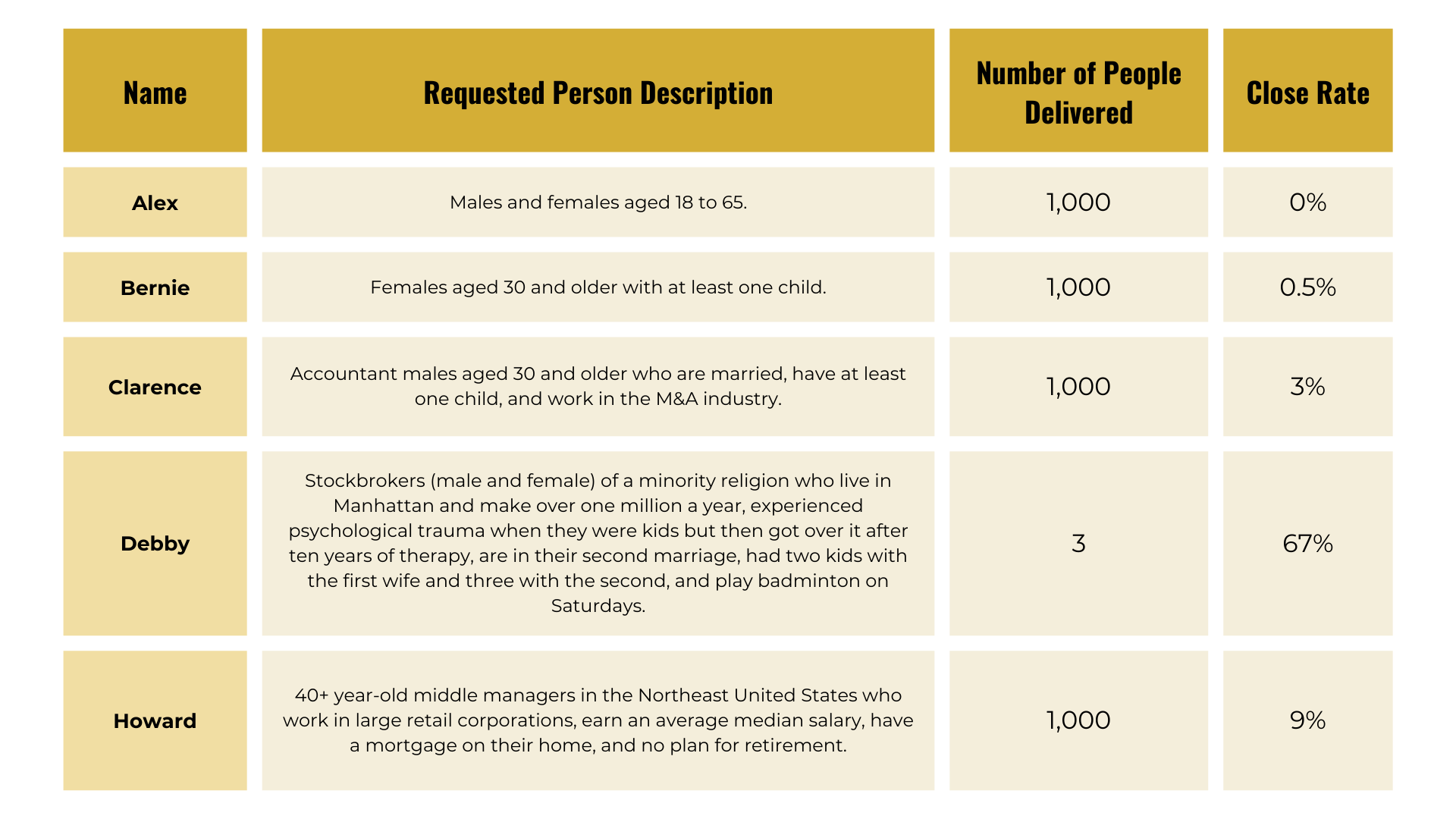
- Alex didn't close anyone.
- Debby had the highest close rate, of 67%. However, she only had 3 people delivered to her. (Yes, the genie promised 1,000 people, but these people have to exist...)
- Aside from Debby, everyone's close rate was less than 10%, with Howard's being the highest at 9%.
Now, the next natural question is... why?
Why are these the results? And what implications do they have?
Let's now take a look at everyone's business, see how they match up with their requested person description, and see how we could get you a better result than a 9% close rate.
The Genie Was... Disappointed. Here's Why.
It's time to take out the paper where you wrote down your predictions of everyone's business and check it. How close were you?
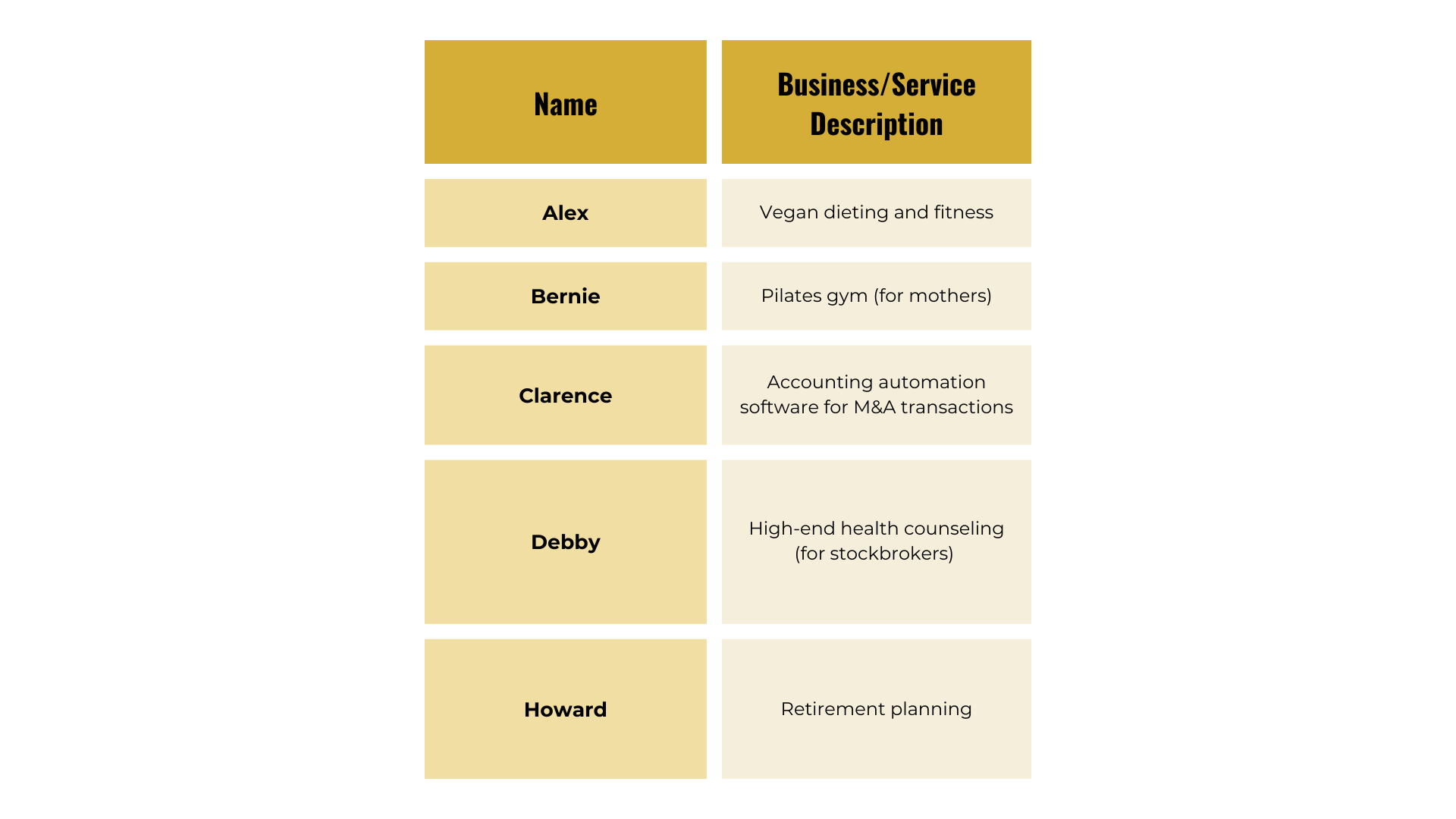
If you're like the rest of us, you might have had a reasonable chance of guessing Bernie, Clarence, Debby, and Howard, but no chance of guessing Alex.
Why?
Well, who fits Alex's description of males and females aged 18 to 65?
About 5 billion people.
These 5 billion people have as many different wants and needs as you can imagine and work across all the sectors, so it's kind of hard to figure out exactly what Alex would do from that description alone.
So, Alex's description was extremely vague (and indeed, the genie grumbled when he granted the wish). We can probably guess, then, that he isn't very clear on his ICP and thinks that his product is for "everyone."
In that case, he should go and review the previous chapters in our CCC newsletter so he can get clear on who he actually serves.
On the complete other side was Debby, who gave an extremely detailed description—and therefore has a very fleshed out ICP. But were all the details she included really necessary? Or did they limit her too much? (Only she can answer that. Really, it depends on how much each person is worth.)
In the middle, we had Bernie, Clarence, and Howard, who had a reasonably specific outline of whom they wanted the genie to get them. As you can guess, they had the kind of ICP that I expect many of us start with before we really get deep into crafting our ICP.
But how does all this tie into the close rates?
The Close Rates—Explained
Here are the genie's own thoughts on why they each closed what they did:
- Alex: I gave him a randomly selected group from the 5 billion people. Turns out, only about 1-2% of the world population is vegan, so he got all meat-eaters. He should have been more specific.
- Bernie: I gave him a randomly selected group, like for Alex. She didn't really specify location, so she got a mix of mothers across nationalities, and only a few of them were actually interested in pilates—even fewer had the time for it, because most of the mothers had newborns.
- Clarence: He had a reasonable close rate—in fact, I suspect it's about what most people get when they do cold outreach. The audience I got him was cold, so this isn't altogether unexpected.
- Debby: I got her all the people who fit her criteria, and it turned out that two out of three of them suffered from the problems she faced. Keep in mind though that she had a much smaller sample than the others, so her close rate is very high but with very low volume. (Debby actually tried to sue me for only getting her 3 when I promised 1,000, but then I reminded her I'm a genie and not a legal entity...)
- Howard: Howard had a much better close rate than Clarence did by about 3 times. I think it's because he specified these should be people who don't have a retirement plan, and actually about 10% of them got scared by the recent market volatility and felt that even though they considered themselves to have relative job security, now was a good time to start planning for the future.
Pay attention especially to the genie's comments about Howard. Did you notice that he mentioned an external event that caused Howard's prospects to really consider doing business with Howard?
As we've alluded to with the tale of The Merchant and the Four Döppelgangers, the buyer's journey plays a significant role in influencing your prospects' behaviors.
Now, we're going to look at this deeper, keeping in mind other factors (such as external influences) that naturally group your future clients into different buckets, and we're going to do it using GBB Media's proprietary D-Model.
Introducing the D-Model
At GBB Media, we have a simple illustration we like to use to explain the complex buyer's journey to our clients.
It's not a funnel.
It's not a formula.
It's not a hack.
It's a graph.
Here it is.
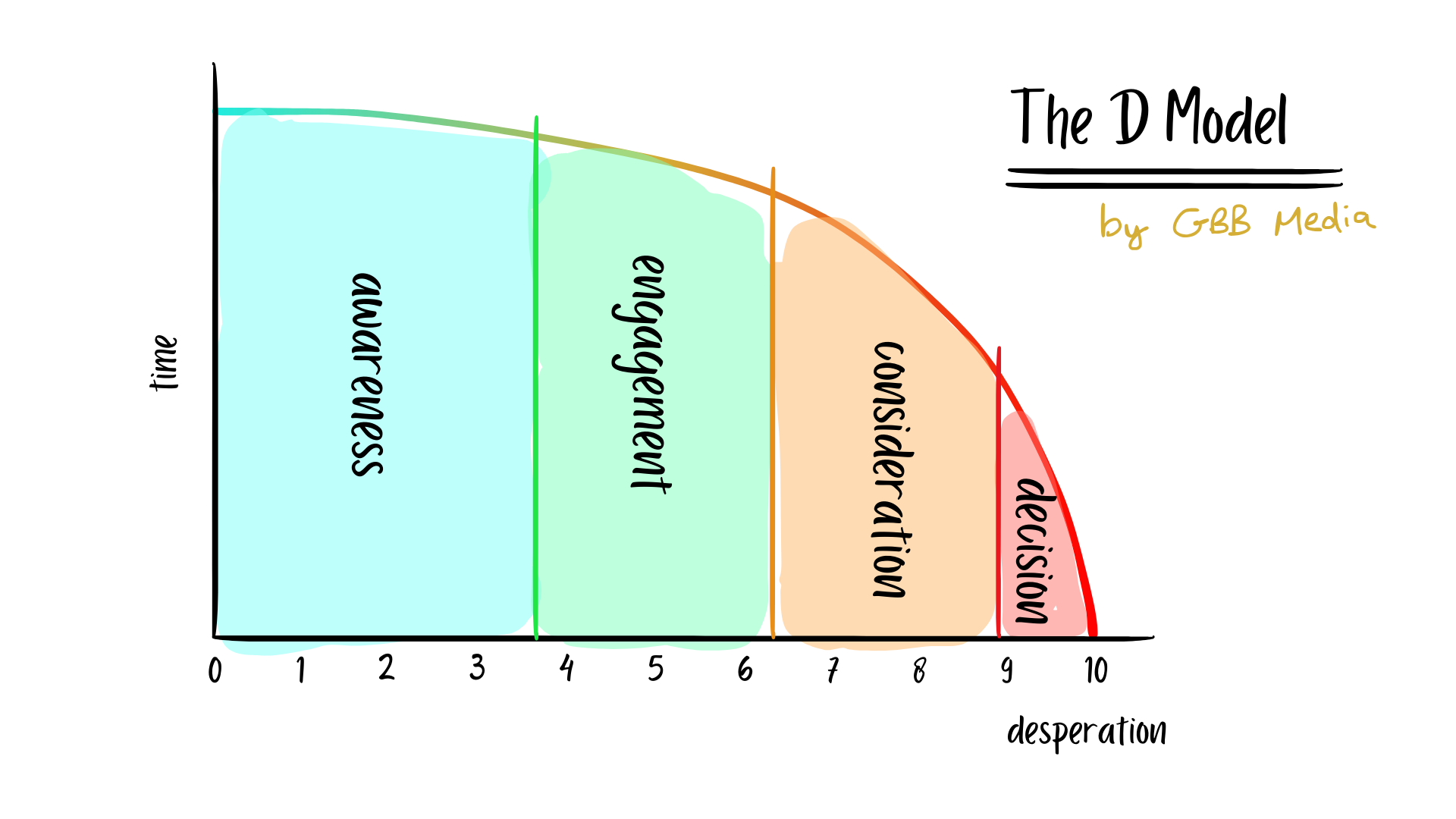
Let's unpack it piece by piece:
- The axes are time (measured in months or years, usually) and desperation
- By time, we mean the time to conversion or sale (which is the goal)
- When we say desperation, we mean a relative measure of how much pain your prospect is in and how badly they need the solution you provide
- Desperation is rated on a scale from 0 to 10—with 0 meaning the person currently has no need at all for what you offer, and 10 meaning they will sell their soul for it
- The curve itself is downward sloping (indicated as the line that's colored in gradient from blue to red)
- The curve is divided into four sections:
- The awareness section, which corresponds to the awareness stage of the buyer's journey
- The engagement section, which corresponds to the engagement stage of the buyer's journey
- The consideration section, which corresponds to the consideration stage of the buyer's journey
- The decision section, which corresponds to the decision stage of the buyer's journey
So that's it 🙂 That's our D-Model. (The "D" stands for desperation, by the way.)
Now, you might be thinking, "That's a pretty graph and all, but... how exactly is that different from a funnel?"
The secret lies in how you read it.
Let's walk through a simple example to see the full power of the D-Model in action. We'll use Howard's business and ICP to make things easier.
The D-Model in Action
When putting the D-Model in action, we mainly focus on the curve:
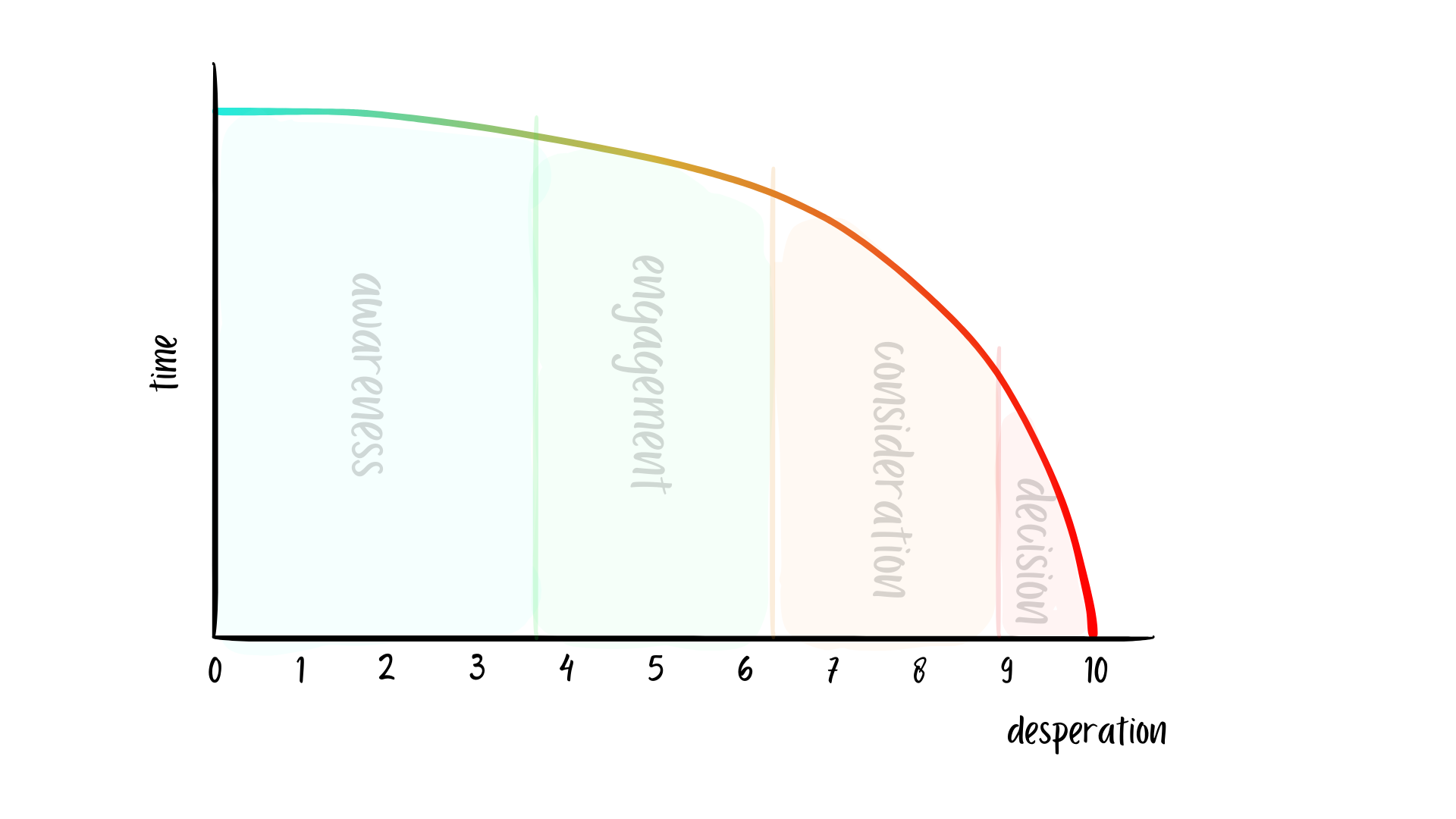
To understand how we use this curve in relation to our ideal prospect, it's important to keep in mind the key concept we discussed in the tale of the Merchant and the Four Döppelgangers—that you can have your ICP spot on, but that your ideal prospect exists in different versions depending on the stage of the buyer's journey they're in.
Now, we can examine this in deeper detail. The stage of the buyer's journey is related to how desperate they are for a solution. If they don't even know they have a problem, they're all the way to the left side of the D-curve, at the awareness stage. If, however, they know they have a problem and need a solution yesterday, then they're all the way to the right of the D-curve.
The curve is smooth because all these versions of our ideal buyer are out there, forming a sort of continuum. But if you want to focus on one version of your ideal buyer—i.e., a subgroup of the population of all your ideal buyers—you can isolate them based on where they are on the journey, and therefore plot a specific point on the D-curve.
Let's see this in action with Howard.
As we know, Howard deals with middle managers who have no retirement planning. The same person can have different degrees of need for Howard's retirement planning services, but let's suppose that Howard wants to specifically target his ideal buyer who has a high D-score—let's say, around 9.
We can plot this point on the curve:

Let's take a second to notice a few things about this point:
- The prospect at this desperation score would lie in the decision stage of the funnel
- The time to conversion is considerably lower at this point than it would be at points to the left of this point
With this in mind, how hard do you think it would be for Howard to close a prospect at this point?
Probably not very hard, right? I mean, compared to a prospect in the awareness stage, someone in the decision stage is much hotter and closes much faster.
So, if Howard can target the subgroup of his ideal buyers who are already at this D-score, then he can get much better bang for his buck, since more of these people will close, and faster.
But now the question is, how can he figure out who's already at this stage?
This is where we go from the simple D-Model illustration to the more complex one (which we reserve for more detailed and nuanced analysis), but for our purposes here, we'll just introduce some of the considerations we use to help our clients figure out this subgroup:
- Internal factors. Internal factors are powerful motivators to action. So we consider what might have recently changed in the person's disposition that might cause them to act now—e.g., patience gone, restlessness with their current situation, a new desire that requires them to be higher than they are now, etc.
- External factors. External factors are circumstantial changes (political, social, economic, environmental, etc.) that can affect a person's sense of urgency. Here, we think about what events in the world or local regions where our prospects live might be prompting action now—e.g., economic downturn or uncertainty, social changes or new laws, political speeches or rallies, changes in weather or environmental conditions, etc.
In the case of Howard, here's what he might consider for a high-level analysis:
- Internal factors: Howard's parents may have just retired without enough money, or they may have finished comfortable savings, so he might be facing the fear that he will be like that, too. He knows that he doesn't want to work all his life, but he's only now starting to think about what will happen after retiring.
- External factors: Howard may have seen on the news that there's an economic downturn heading his way and is worried about his prospects now, as well as in future, to save and live comfortably.
When doing this type of analysis, having a very strong ICP that documents psychological, motivational, and behavioral (as well as demographic) information about your prospect is essential, as it will be the basis you have for predicting the effect of events on your prospect, and understanding how different factors can affect their behavior. Even if you have to start doing research on top of it, you'll already have a strong base on which to start.
Why Do All This Work?
You may be wondering, why in the world would you want to do all these analyses and all this thinking to identify subgroups within the subgroup that is your ideal client pool?
The answer takes us right back to where we started—the sales genie question.
Imagine if, when the sales genie asked you for whom you want him to bring you, you answered with not just your ICP, but the description of the subgroup within your ICP that is most likely to convert? You wouldn't just be pointing him to the right tree—you'd also be pointing him to the lowest hanging branch, meaning you'd be maximizing your opportunity!
Once you've identified the specific characteristics or traits that characterize the subgroup of your ideal buyers who are ready to buy (in the decision stage), you can target them right away and get the low-hanging fruit.
That means you don't have to settle for 1-3% close rates—you can get rates that are much higher, meaning more clients and more money.
A Few Other Notes
This chapter's already pretty long, I know. But I wanted to end with a few extra cool features of the D-Model that will help you better understand the true power of content marketing.
Look at the graph again.
Suppose you create content that's targeted specifically to the decision stage. Then, it nurtures people in the decision section.
But what happens when you create content that's targeted to the engagement stage, for example?
Then, it nurtures everyone in the engagement stage... but it also helps to nurture people in the consideration and decision stages.
Think about it, and you'll see why this is true.
Let's say I was in the market for a new phone, but had never heard of Apple. Seeing Apple's CTA to buy their latest iPhone would have no real effect on me, since I don't know Apple or the iPhone and therefore am not interested in buying their phone.
But what if I were interested in buying an iPhone (that would put me in the consideration stage), but saw an infographic on social media describing what different types of people should look for in their phone (an engagement post)?
I'd find that valuable.
And it would further reinforce the trust I have in their brand, since they're demonstrating their authority in the tech space.
The effect of content trickles from left to right, meaning that even if you're doing brand-building content, it's not a waste if the time-to-conversion is years and not days. Every bit helps to build your presence, your brand, and your value in the eye of the consumer.
And that's why content marketing is never a waste, regardless of the stage you do it in.
(We at GBB just like to do it the more strategic way—the way that maximizes your return on investment the quickest.)
Get Your D-Model Template
If you made it this far, congrats! You deserve a gift 🙂
So, our team has prepared a basic D-Model template that you can fill out to start leveraging the power of this model yourself.
DM us for your free copy 🙂
In our upcoming posts, using the D-Model as our framework, we'll dive into the different types of content that you can create, how to maximize their effectiveness using the information from a D-analysis, and how to make your content marketing cashflow $$$.
Excited?
Great!
See you there 😉
P.S. What kind of answer did you give regarding your ICP? How well do you think you would have scored with the sales genie? Send us your screenshot. We'd love to see you apply these ideas in your marketing.