
How-To Guide | Content Creation
Our Framework for Interest-Based Content Creation (with Examples for CFOs)
By Jules | 6 June 2025 | 11 min. read
Want the Short Version? Get the Infographic!
Download the free infographic summarizing our framework. (No email required.)
How do I actually reach my target audience, not my peers, on LinkedIn?
This is a question we get a lot from small business owners who have been posting for a while, but haven't been noticing any traction. At least, traction with the right audience.
You might appreciate that fellow CFOs are liking your stuff for the first few months. But after that, it becomes more frustrating than anything, because unlike your target buyers, your peers won't give you money in addition to likes and hearts.
Well, you already know what the problem is. This post isn't designed to rub salt in the wound, or explain the echo chamber phenomenon you may be fighting.
Instead, this is your how-to guide that will take you through the exact process we follow in identifying and designing interest-based content topics.
Don't worry, it's really simple. But that doesn't mean it's always easy.
You'll need a legal pad, a pen, a highlighter, and some mental juice to pull this off. So go grab those things (and some coffee, tea... whatever your fix is).
Okay, I assume you're ready. Let's dive in.
Materials List
- legal pad
- pen
- highlighter
- some mental juice
If you prefer the digital version, here's a Google Doc template you can use. (Still come with some mental juice, though 🙂).
Duration
30-60 minutes
The 4-Step Framework for Generating Interest-Based Content
Step 0: Step Out of Your Frame of Mind
This is the prerequisite step, and the one that's so easy to overlook.
Before you do anything, you need to step out of your current frame of mind, and take an outsider's view.
You're not a CFO or any kind of finance professional anymore.
You're a neutral observer.
This mindset shift is essential if you want to get good results from your brainstorming.
Step 1: Understand Your ICP
Okay, you shifted your perspective and are ready to tackle the work.
This framework presupposes that you already have a great ICP documented, so now is the time to take it out and read it.
Really read it.
Don't autofill sentences. Don't recite information to yourself in your mind.
Pretend this is the first time you're ever coming across this document, and take time to understand it as an outsider. Remember, you have no knowledge of your business.
When you feel confident that you understand the characteristics, thought patterns, and mindset of the person whose profile you've just read, move on to Step 2.
Step 2a: Make a List of Your ICP's Interests
On your legal pad, draw a line straight down the middle, running from the top of the page to the bottom. To the left of that line, start listing down topics, ideas, titles, or anything that comes to you that your ICP would be interested in.
Start this exercise by listing (at the top) 3-5 big keywords that really matter to your ICP and that are part of the very fiber of their being.
For example, if you serve small business owners, those would be revenue, growth, profit, clients.
(If you serve large business owners, by contrast, those could be more like revenue, expansion, efficiency, etc. You get it.)
Then, under the keywords, list topics and subtopics that would pique this person's interest.
Continuing with the small business example, these topics could be:
- increase revenue
- grow my business without overhead
- get more clients quickly
- grow my team
- hire better
- get more bottom-line profit
- replace lazy team members with AI
Again, remember that you're not you, the finance professional. Don't let your finance lens limit you.
Side Note
The topics you choose can be limited to your ICP's professional or business interests, or they can encompass lifestyle and personal interests. That depends on your values, brand, and the type of digital footprint you want to create. Practice some self-awareness here.
Think from your ICP's perspective, and write down anything that comes to mind related to the big keywords, even if it's not in your area of expertise.
Step 2b: Make a List of Your Areas of Expertise
Great job so far. Being someone else is exhausting, so that's enough of that; it's time for you to return to being you!
To the right of the line you drew down the middle of the page, you'll now go through a similar process as Step 2a, but you'll write down topics that you can speak to.
Don't worry about cross-checking against the list you made in Step 2a. Just write down anything that comes to mind that falls within your areas of expertise and passion.
For example:
- tax advice
- setting up financial infrastructure
- passing audits
Really, anything that you can speak to with authority and enthusiasm.
Step 3: Find Areas of Intersection
Time to bring out the highlighter.
Now that you have the two lists written down, go through both and highlight whatever is a commonality between the two lists.
For example, maybe on the ICP side you see "grow my business without overhead," and on your side you see "cost optimization to reduce overhead." These two are close enough to be equivalent and are areas of overlap, so they should be highlighted.
What if you don't see any overlap?
Don't worry, it's there. You either need to look harder (they're often not the same word-for-word, or the concepts are complementary) or you need to expand the lists until you find areas of overlap.
Or, if none of that works, then it means you're not serving the right ICP. After all, if you have nothing that they would be interested in, and they have nothing that you can speak to, that's a clear mismatch, right?
But in most cases, it's the former, not the latter, so keep going until you find the overlap 🙂
Step 4: Formalize Content Topics (and Create the Content)
Once you've found the areas of overlap, you have the seeds of your content topics.
Congratulations!
Now, you can take those seeds, refine them, and generate more concrete topics that you can speak to and create content about.
Of course, then your next step is to actually create the content. All the lists in the world won't help you get in front of your ideal audience unless you actually use them 😅
So once you've reached this point, simply jot down your key topics in your favorite project manager or another page of your legal pad (to avoid clutter), and then get to work 🙂
If you'd like to see an example before you go though, read on. (But then, seriously, get to work.)
Example: Fractional CFO Serving Artists
Let's use a real-world case of a fractional CFO serving a particular kind of small business owner in Miami: artists who are trying to make a business of selling their art (wares, crafts, paintings, etc.).
Here are some key features of his ICP:
- they have a Shopify store
- they've made some sales in their store, but mostly to friends, family, old colleagues, and people they've met at events
- revenue is within a $100K - $500K range
- they want to get more strangers to buy their stuff
- their big vision is international expansion
With this information in mind, we helped him create these two lists:
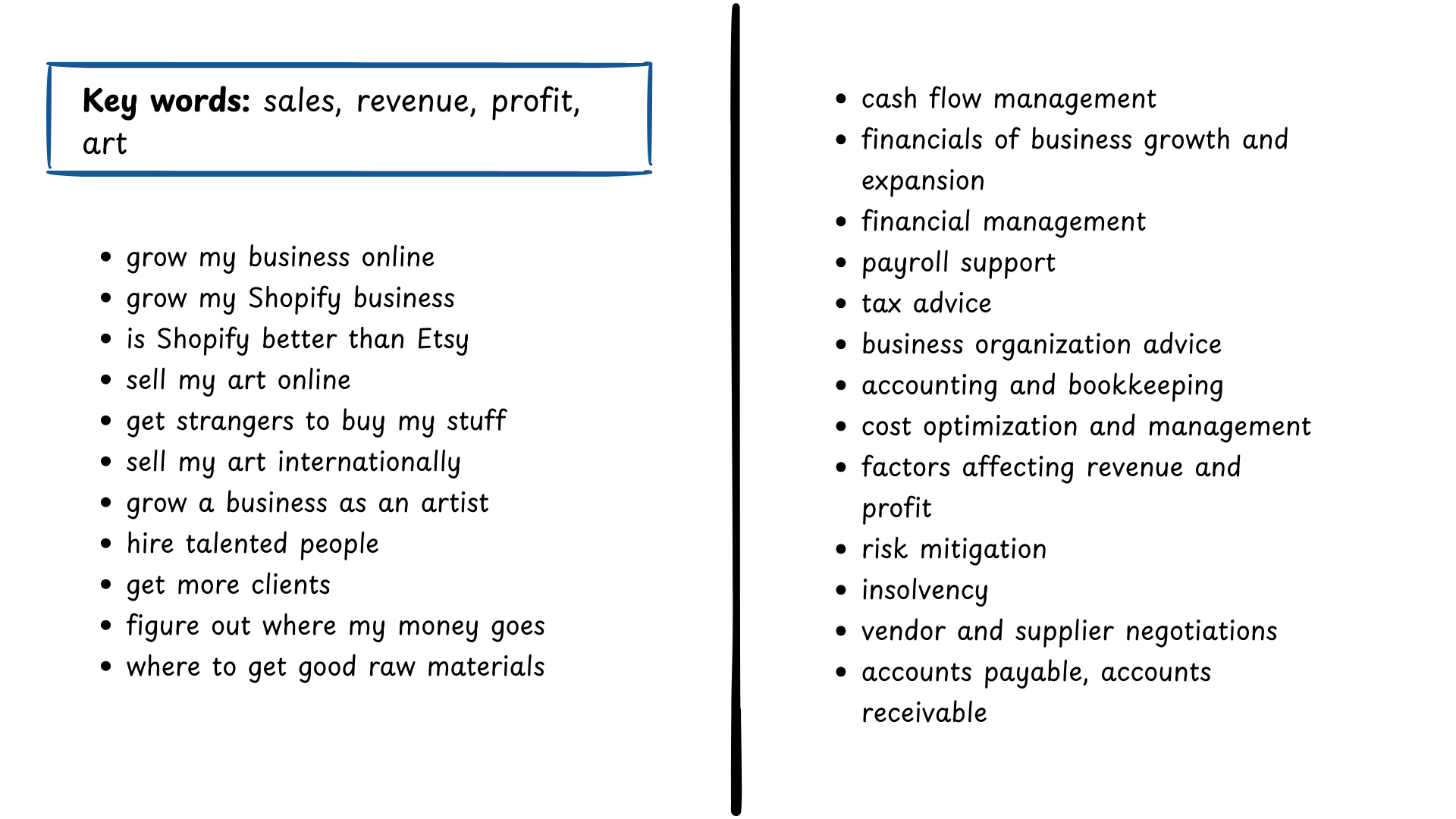
Then, we passed the highlighter:
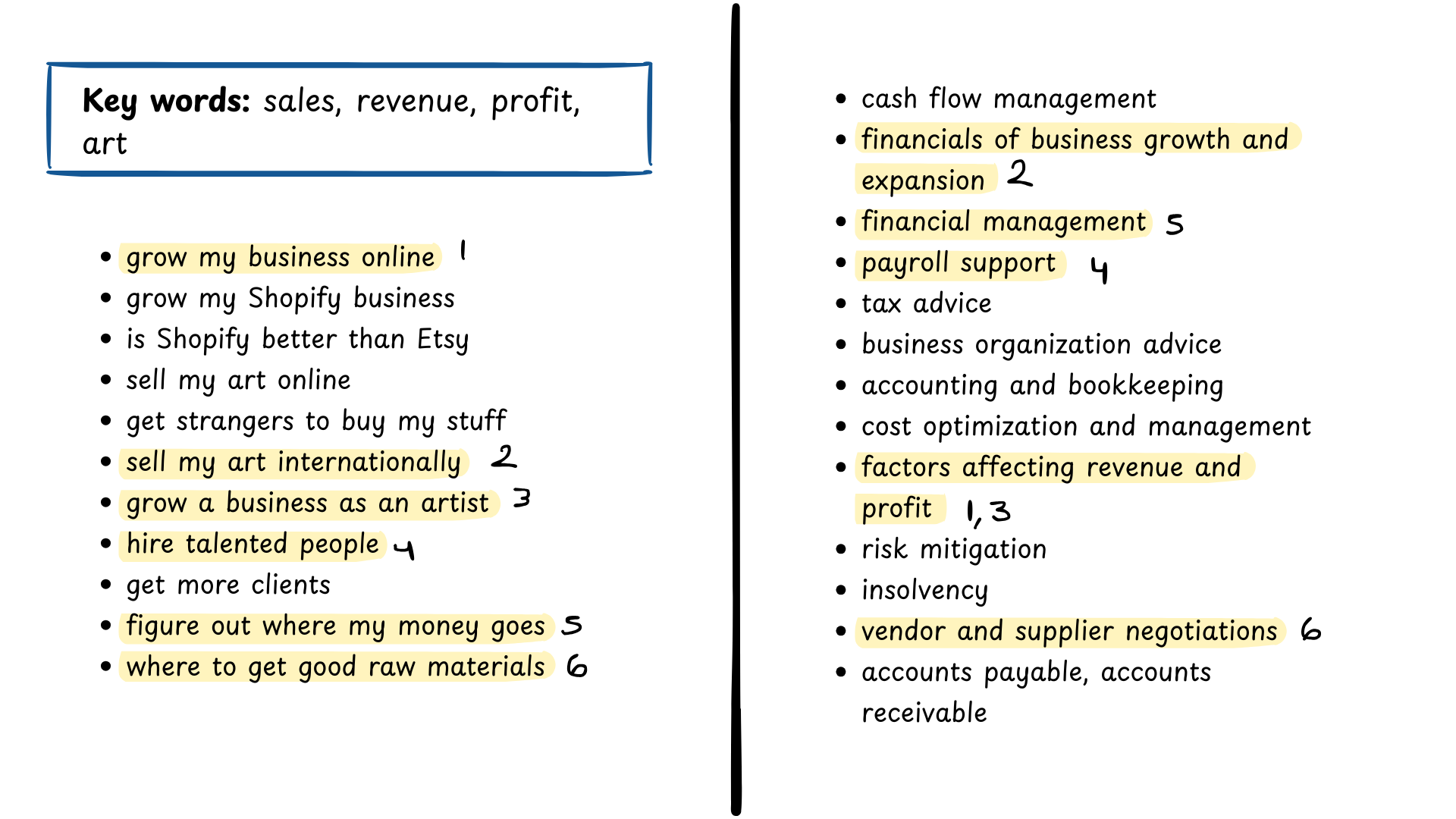
And here are some more concretized topic ideas that we put together:
- under the category of "grow my business online/as an artist," we can talk about
- what really affects the revenue of an art-based business
- how to make art-based businesses more profitable
- under "sell my art internationally," we could create an asset titled, "Thinking about international expansion? What every art-based business needs to know."
- under "figure out where my money goes," we can talk about
- how to keep track of cash in an art business
- how to handle cash transactions in a digital system from one-off local deals
- under "hire talented people," we could speak to how payroll can help artist-business owners manage and even attract talent without breaking the bank
- under "where to get good raw materials," we can talk about
- how to negotiate with raw material vendors to get good deals
- the importance of good supplier relationships for art-based businesses (and how to build them)
- how to evaluate suppliers from a financial standpoint (this could be a guide or checklist)
I hope this was enough to show you that with just a little bit of creativity, you can exponentially enhance your relevance to your ideal client, and therefore the likelihood that they see your great stuff on LinkedIn.
Now, It's Your Turn
Do the exercises.
Identify the topics.
Create the content.
Go.