
How-To Guide | Marketing Strategy
How to PIP: The GBB Media Guide for Identifying Problems
By Jules | 15 September 2025 | 16 min. read
Want an Actionable Roadmap? Get the Infographic!
Download the free infographic summarizing our framework. (No email required.)
TL;DR
We use PIP (problem identification and prioritization) sessions with our clients to identify the real constraints in business growth and devise a plan to address them. The CAP (constraint, approach, process) framework guides our sessions.
Entrepreneurship is a bit like painting: It can be very messy, or it can be mildly messy. The difference depends on how you approach it. (Think a 5-year-old artist vs. Van Gogh nearing the end of his life.)
When it comes to growing a business, messes are inevitable. But we've seen many cases of founders who accidentally created more messes than necessary by neglecting Step #1 of growing a business.
What's Step #1 you ask?
Identifying what the business needs to grow.
In other words, identifying and prioritizing business problems, to then address them through proper action. (Which is Step #3. But many founders prefer to skip over #1 and #2 because that's where you get to do 'sexy things' like post content or run campaigns.)
Sounds simple. But simple is often mistaken for "easy" and "unimportant," which means that a surprising number of startups face problems just because Step #1 was overlooked.
In fact, I think I'd prefer to call it Step #! (yes, exclamation mark) to emphasize how important it is to making sure you set up the right foundation!
We at GBB Media have fixed this for our clients informally over the years, but now that we've decided to help as many startups DIY as possible, we've formalized our method into a structured framework that you can execute as soon as you're done reading this post.
The answer to doing Step #! correctly? It's called a PIP session.
In this guide, you'll learn what it is, how it works, and what not to do (looking at our consultant friends who think a meeting = solving the problems).
You'll also get a printable document that covers the framework behind PIP (which we call CAP, for reasons you'll see) so you can have it as a guiding roadmap during your PIP session.
The three steps to growing a business?
Step #!: Identifying what the business needs to grow.
Step #2: Creating a plan to address constraints and give the business what it needs to grow.
Step #3: Taking action to give the business what it needs to grow.
And by the end of this post, you'll have Steps #! and #2 down.
Ready?
Let's go.
The PIP Session
Brass tacks: A PIP session is just a meeting where we identify and prioritize problems. If you're wondering where the term came from, it's because someone got tired of writing "problem identification and prioritization" in our team comms and decided to abbreviate it. Plus, "pip" sounds better.
The goal of the PIP session (and yes, there's usually only one over a period of time) is to come out with a crystal clear understanding of your current business constraints and how they rank in order of priority. Basically, your end result is a numbered list, with some added strategy.
Why is this essential and why did we feel the need to develop this for our clients?
Because when we ask founders what problems they're currently facing in marketing, we get answers like this:
- "We need to get out there."
- "We need more business."
- "Our problem is leads."
The first one basically means nothing. The second and third ones are common and they might make sense—until you find out that the company is already at capacity in fulfillment and the last thing they actually need is leads.
So, to make it very straightforward (and replicable) for our clients to identify constraints, we formalized PIP sessions based on an underlying framework that we call CAP.
What's that about?
The CAP Framework
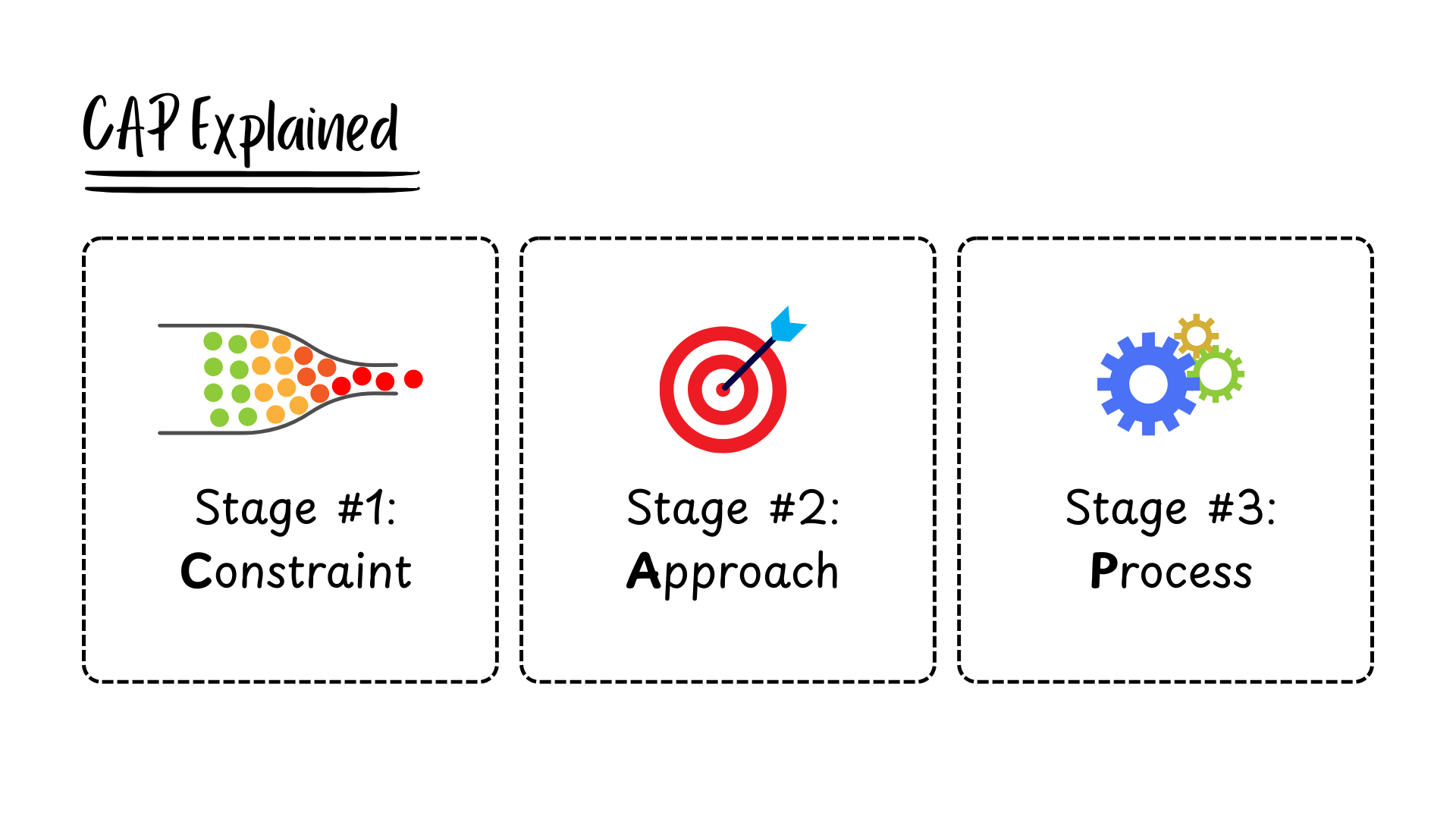
We divide our PIP sessions into 3 stages:
- Stage #1: Identifying the current constraint(s) of the business
- Stage #2: Identifying our approach to the identified constraint(s)
- Stage #3: Identifying the process we will execute in line with our approach to address the identified constraint(s)
You'll notice that only Stage #1 is actually strictly tied to problem identification; Stages #2 and #3 focus more on creating a plan to addressing the problems.
That's because we don't believe in meetings without solutions, so we had to work that in. But most people fail at Stage #1 anyway, so even if that's all you get out of the framework, you'll already be ahead of more than 50% of other founders.
Okay, let's break this down so it's a bit more concrete. Here's the master flow chart of what the CAP framework entails, so you can keep the big picture in mind; in the next few paragraphs, we'll unpack it piece by piece.
Stage #1: Constraint
We've found that Alex Hormozi's simple constraint model is effective, so we borrow that.
There are 2 kinds of constraints (that just come from the basic laws of business):
Supply
This means a constraint on your delivery and fulfillment side. It's one that creates a blockage internally and also one that's solved internally via operations.
Demand
This means a constraint on the client side--meaning, you have everything on the delivery side, but you don't have enough people coming in. It's an 'external' blockage because you can't solve it by changing your operations.
How do you know which kind of constraint you have? Here's a quick 1-question test.
If you doubled the number of clients you have right now, what would happen to your business?
(a) It would break.
(b) It would grow (maybe even double or more).
That's not a conclusive answer but it gives you a quick idea of where you are.
If you're leaning more toward A, then you're probably more supply constrained. If you're leaning more toward B, then you're probably more demand constrained. Most businesses are a mix of both—they have room to grow up to a certain point, but then they will become supply constrained.
And that's fine.
What you identify during a PIP session is not meant to apply for the rest of your business life. It's just meant to identify what's holding you back now.
As for what will hold you back later—feel free to leave that for later, or if you're a strategist, start planning ahead while you get unstuck.
Stage #2: Approach
Now it's time to work on getting unstuck. And the best place to start once you've identified what's keeping you stuck is to come up with your approach.
We developed this stage because, working with companies of various sizes, we realized that the approach (not just the tactical process) is really important for shaping how you get unstuck.
Now, the kinds of approaches you have at your disposal depend on whether you're supply- or demand-constrained. But we'll keep it simple for now and assume that you (like most other startups and small businesses) are demand-constrained.
There are 2 main approaches:
Broad
Meaning, you go at getting unstuck a little indirectly. (I'll explain.)
Specific
Meaning, you take the most direct route to getting unstuck.
As a startup, you might be wondering why the heck anyone would want to get unstuck "indirectly." But actually, larger companies do benefit from this kind of approach, and you'll see exactly what I mean when we get to Stage #3.
Speaking of...
Stage #3: Process
Stage #3 is all about the process of how you'll get unstuck—as in, what specific actions will you take?
Suppose your constraint is on the demand side. Then, regardless of your overall strategic approach (broad or strategic), some tactical actions you could take to get unstuck include:
- paid ads
- branding plays like PR and awareness content marketing
- partner/referral programs
- sales and closing optimization
But these actions aren't actually 'the same', because some will get you more direct results, while others won't.
Let's see:
- Paid ads are the most tried and trued way to get near-instant results (though they're short-term).
- Branding plays are always a long game, because no amount of branding will get you a direct sale, especially if you're starting from obscurity. If you're Nike, it's different—a "You Can't Win, So Win" campaign will definitely boost sales—but it's safe to assume you're not Nike.
- Content marketing is both a short and long game, especially depending on how it's done (we should know; we've built our business on it). For example, posting on social media to get views or go viral is branding, while posting sales-enabling content is part of lead generation (more direct).
- Partner/referral programs can be either, depending on your business structure and whether you're already getting most of your business from referrals.
- Sales and closing optimization is definitely a direct route to new business.
So, if your approach is broad (i.e., can involve detours), then you'll see that as your process, you could choose
- branding (including branding-focused content marketing)
- loyalty programs system optimization
- partner/referral programs (depending on your business)
for example.
But if your approach is specific (i.e., you need to get from A to B stat), then your process could be
- paid ads
- content marketing
- partner/referral programs (depending on your business)
- sales and closing optimization
for example.
Usually startups and small businesses need a specific (i.e., direct) approach to getting unstuck.
Only when you get to a larger scale can you afford to go the indirect way, which companies often do because they get influence and market share or brand equity in the process of growing. (None of these things matter if you go bankrupt. So small businesses don't need to worry about it. Hence our pragmatism.)
How to PIP—With a Roadmap
Okay, so that was a high-level overview, but how do you actually do a PIP session? Like, right now?
Let me walk you through it, then you can do it with your team.
Materials List
- pen and paper (or virtual document)
- our roadmap (to make things easier)
- some mental juice
You can download our roadmap here.
Duration
30 minutes (45 if you're feeling generous)
Start: Stage #1
Stage 1 means identifying your constraint. The easiest way to start is often to just randomly list out what you believe your business problems are, so do that now. Then, look over your list, check each against the supply/demand diagram on the roadmap, and write either "supply" or "demand" next to each problem.
Done?
Good.
Now, circle the biggest one. The one that's costing you the most money, peace of mind, or both. The one that you would wish away if you had a business genie at your disposal.
Great. That's your priority #1. Feel free to ignore all the others, or just rearrange them in order of decreasing pain for your future reference.
Work with your priority #1 as you move to Stage 2.
Stage #2
Now, consider your approach. We recommend choosing it based on your size, runway, and business goals. Usually this means:
- startup or small business (< $10M revenue) → specific
- medium-to-large enterprise or above ($10M+ revenue) → either specific or broad, depending on your goals and timelines
By the by: You'll notice that the roadmap doesn't break down the approach on the supply side into "specific" or "broad," but instead into "systems" and "people." That's because these are the two major categories we've identified cause blockages in your fulfillment process. This isn't a size or goal thing, so pick the one that pertains to your particular situation.
Keep in mind your approach as you consider your options in Stage 3.
Stage #3
Have a look at the process options that pertain to your constraint type (supply or demand) and chosen approach. Which of these do you want to implement? Pick as many as you want, although keep in mind that focusing on one process at a time (especially if you have limited capital) is usually more effective.
Next Steps
Once you've made your choice, you're done. That's it. The next move is to implement correctly, which means finding the right resources and/or partners to help you.
Now, if you've read anything we've written, you know we're in the content marketing space. So we're really big advocates of doing content marketing for client acquisition. If this is the route that interests you, then you're in luck. If you're in the tech industry doing anything remotely related to pentesting, cybersecurity, or security consulting, then you're even more in luck.
Because we're releasing a new series that walks you through how we would approach building a content-powered client acquisition engine for a fictional boutique cybersecurity consultancy, modeled on our real experience. We're including not just the bare bones, but detailed plans and explanations, checklists, tools, and even sample content assets—in other words, everything you need to DIY.
Interested? Check out our series here. And hey, you can see a PIP session in action, too!
Check Out Our Cybersecurity Series!
See exactly how we identify and solve the marketing problems faced by a boutique cybersecurity consultancy.