
The Digital Farm Series | Chapter 1
The Sectors and Structure Overview
By Ace | 4 April 2025 | 20 min. read
JUMP TO SECTION: Preliminaries | Sector 1 | Sector 2 | Sector 3 | There’s More.
Welcome to the first formal installment of GBB Media’s Digital Farm Series—a comprehensive guide designed to reshape your approach to digital marketing, turning you from a reactive tactician into a preeminent strategist.
Sound interesting?
Or perhaps confusing?
If I lost you at the term “digital farm,” read this article first and then come back.
If, however, you felt a tingle of excitement at the prospect of being able to outthink, outperform, and outshine your competitors, then read on.
Over the following chapters, we’ll delve deep into the nuances of our digital farm strategic framework, exploring, in detail, the structures, interrelations, and applications of the various components that make up the farm.
Wondering if your business is ready for a digital farm, or what parts of this journey you should focus on?
Take our quick self-assessment to get a customized roadmap for your digital farm journey.
However, to avoid getting lost in details with no sense of direction, we will sensibly start with an overview.
And that is the purpose of this chapter: to give you a survey of what you can expect, and to break down at a high level the elements of this diagram.
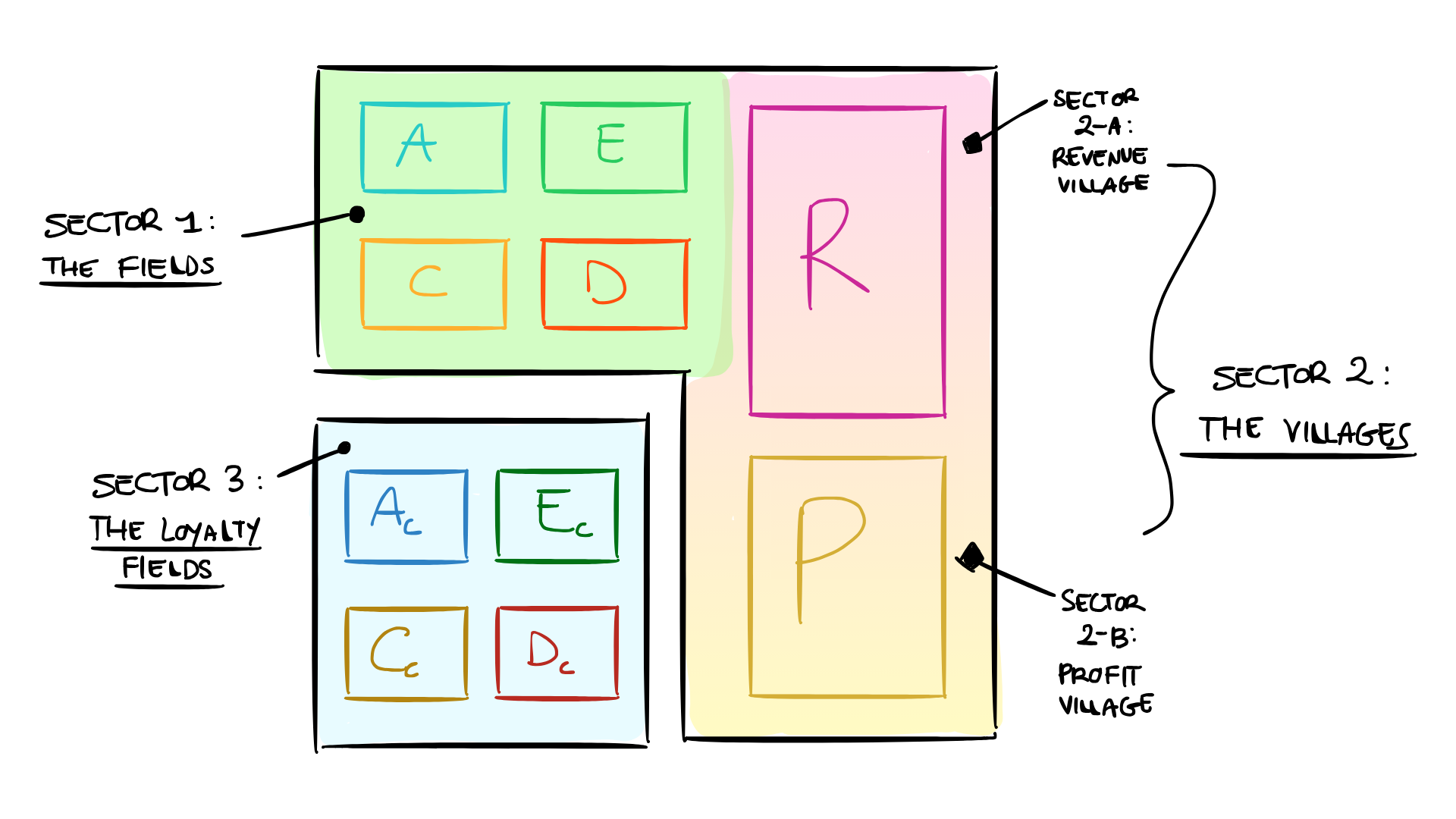
A basic digital farm consists of three main sections (referred to as “sectors”). These are:
- Sector 1: The Fields
- Sector 2: The Villages
- Sector 3: The Loyalty Fields
But before we analyze what each means, let me start by mentioning a few central concepts that you need to keep in mind when thinking about the digital farm—our ‘axioms,’ if you will, and a few preliminaries.
Preliminaries
This is the most basic unit...
…and the one that we will focus on for most of this series, because most of the business owners that need this series usually only need the most basic farm variation. However, of course, you can get more complicated variations. If you’re curious, the complexity of a business’s digital farm depends on:
- The complexity of the industry—generally, for complex industries like private equity, insurance, and the like, a digital farm evolves into an entity that we colloquially call a “superfarm” (but more on that much later).
- The size of the company—understandably, the larger an organization, the bigger in scale its digital farm will evolve to be.
- The business model—the more complex and multi-layered the business model and structure, the more complex the digital farm becomes, also.
The concept of the digital farm itself is based on two foundational ideas...
…and these, much like the source code of an AI, color everything else. They are:
- Jay Abraham’s Strategy of Preeminence—you can learn more about this awesome approach to strategic marketing and business growth from the marketing master himself.
- the centrality of trust—by this, I mean the basic truth that all human business transactions are based on trust.
-
The crop being cultivated in this digital farm is trust itself.
We’ll come back to this properly when we discuss the trust plant in a later chapter of the series, but for now, keep in mind that every structure of the farm is meant to cultivate trust, optimize trust, or convert trust into something useful for the business.
Trust has multiple layers.
In particular, it has four key phases—each corresponding to a stage in the buyer’s journey. Sound detailed and possibly complex? Well, now you know why the trust plant will have its own dedicated chapter 🙂
The farm concept applies to more than just prospects or clients.
In fact, we have had several use cases of applying it to employees. When we discuss Sector 1 on its own, I’ll share some examples of how you can think about the digital farm beyond its most obvious application and use it to serve various aspects of your business building.
With those important notes out of the way, let’s examine what the sectors mean and what role they play in making a digital farm work.
What Is Sector 1?
Just like an actual farm has fields where crops are cultivated and nurtured, your digital farm has fields that accomplish the same thing. In particular, Sector 1—the Fields—is where you nurture and cultivate the trust of total strangers.
There are four different types of fields, labeled A, E, C, and D. These correspond to the four stages of the buyer’s journey according to our D-Model (you can read more about our D-Model here). To make that extra clear, let’s see the overlap:

The Awareness Field
The Awareness field is where every complete stranger starts from, corresponding to the unaware/unaware and aware/unaware phases of the detailed buyer’s journey.
Translated from marketing speak, this means that the person is either
- unaware of both their problem and of you
- aware of their problem but unaware of you
As you can imagine, the trust such a person has in you and your ability to solve their problem is… none.
So, the purpose of this field is to bring awareness and begin cultivating the first level of trust.
At this stage, “level of trust” might be a misnomer, because there is no real trust they’re developing yet. Instead, this field lays down the preliminary foundation for actual trust-building to begin in fields E and beyond.
Speaking of…
The Engagement Field
Next up is the E-field, which is where the stranger goes from having absolutely no clue about your existence to interacting with you and your assets.
In the old days, back when every business conversation used to happen face to face, this would typically be when you’d have a lunch meeting. You’ve already met the person, but now you’re chatting them up to build rapport.
That’s precisely the goal of the Engagement field—the only difference is that this process is mostly (or entirely) accomplished by content assets, as opposed to interpersonal conversation.
This stage is really where the trust plant actually does start to become about trust. You start showing the person that you can solve their problems, they start to like you, and they start to trust you.
The Consideration Field
Once trust in the Engagement field is mature, the prospect will move to the Consideration field. This is where you get them to start thinking about actually committing to you as their problem-solver.
Before we move on, let me make a proper distinction here to dispel some confusion we at GBB Media have witnessed. Many fellow business owners—especially small business owners—think this is where you post sales content.
But actually, you’re not asking for a sale yet at this stage.
To use an analogy our CEO would approve of, that would be like asking your girlfriend to marry you after only a couple of dinner dates. Yes, she likes you and you’re doing great together; but the relationship still needs to mature a bit more before further commitment.
With that clarification in mind, you might find new questions arising—what content does work at this stage? How do you ought to approach the task of cultivating trust when a prospect is considering you?
The answer is to leverage the power of what we like to call Content for Client Conversion (CCC). I won’t delve deeper into the topic here; instead, we’ll return to it when we discuss the Sector 1 Fields more in detail.
If you would like to read some more on CCC in the meantime, though, I recommend our LinkedIn newsletter, where our founder is sharing more about this precise topic.
Discover Content Marketing Catalyst
By GBB Media
The Decision Field
Last but certainly not least, we have the Decision field. At this stage, the prospect’s trust in you is very mature; all you need to do is assist the sale by cultivating the last stage of the trust plant.
The goal is to position you as the best (and only) right choice for your prospect, while helping the prospect make any decision, whether or not that choice is you.
Does that sound contradictory?
Surprisingly, it isn’t.
You can accomplish both tasks at once by combining Jay Abraham’s Strategy of Preeminence and the process of consultative selling (also by Jay Abraham).
We will discuss this more in depth in later chapters. But perhaps what suffices for now is that you realize that what passes for the traditional “sales” approach isn’t optimized to get you results in the current marketplace.
Cycles and Interaction
Each field follows a “planting-nurturing-harvesting” (PNH) cycle, much like a physical farm field. You start by “planting” the trust plant in that field; then, you “nurture” the plant into growth; and finally, when the plant is mature, you “harvest” it (in marketing, the equivalent is transitioning someone from one phase of the buyer’s journey to the next).
If you were cultivating fields A, E, or C, then the harvesting process feeds directly into the planting process of the next field over (so, the results from harvesting A are used to plant E, the results from harvesting E are used to plant C, and the results from harvesting C are used to plant D). However, if you were cultivating field D, then the result of the harvest feeds into Revenue Village.

Translated back into practical experience, this means:
- If in fields A, E, or C, once the trust plant in the field is mature, the prospect moves over to the next stage of the buyer’s journey;
- If in field D, once the trust plant is mature, the buyer’s trust is ready to be converted into money through a transaction—hence, they move to Revenue Village.
In this way, a prospect moves from A all the way to Revenue Village. We will explore more about PNH cycles and the dynamic interaction of the fields in the dedicated chapter for Sector 1.
For now, we will turn our attention to Sector 2 and explore a little bit more what “Revenue Village” and “Profit Village” have to do with your business.
Sector 2—Where Money Is Made
If Sector 1 is only concerned with cultivating trust in all its phases, Sector 2 is only concerned with turning trust into something useful for the business—in most cases, into money. Because this is akin to how buildings and structures in a farm convert the raw produce cultivated into useful products for the community and beyond, we call these money-converting structures villages. There are two main villages, corresponding to sub-sectors of Sector 2.
These are:
- Revenue Village (Sector 2-A)
- Profit Village (Sector 2-B)
A Bit About Revenue Village
Revenue village takes the mature, buying-ready trust from Field D and converts it into revenue for the business. This part of the digital farm consists of:
- your revenue streams (your products, services, etc.)
- your revenue procurement systems (e.g., referral system, digital marketing funnel, etc.)
Here’s an example visual:
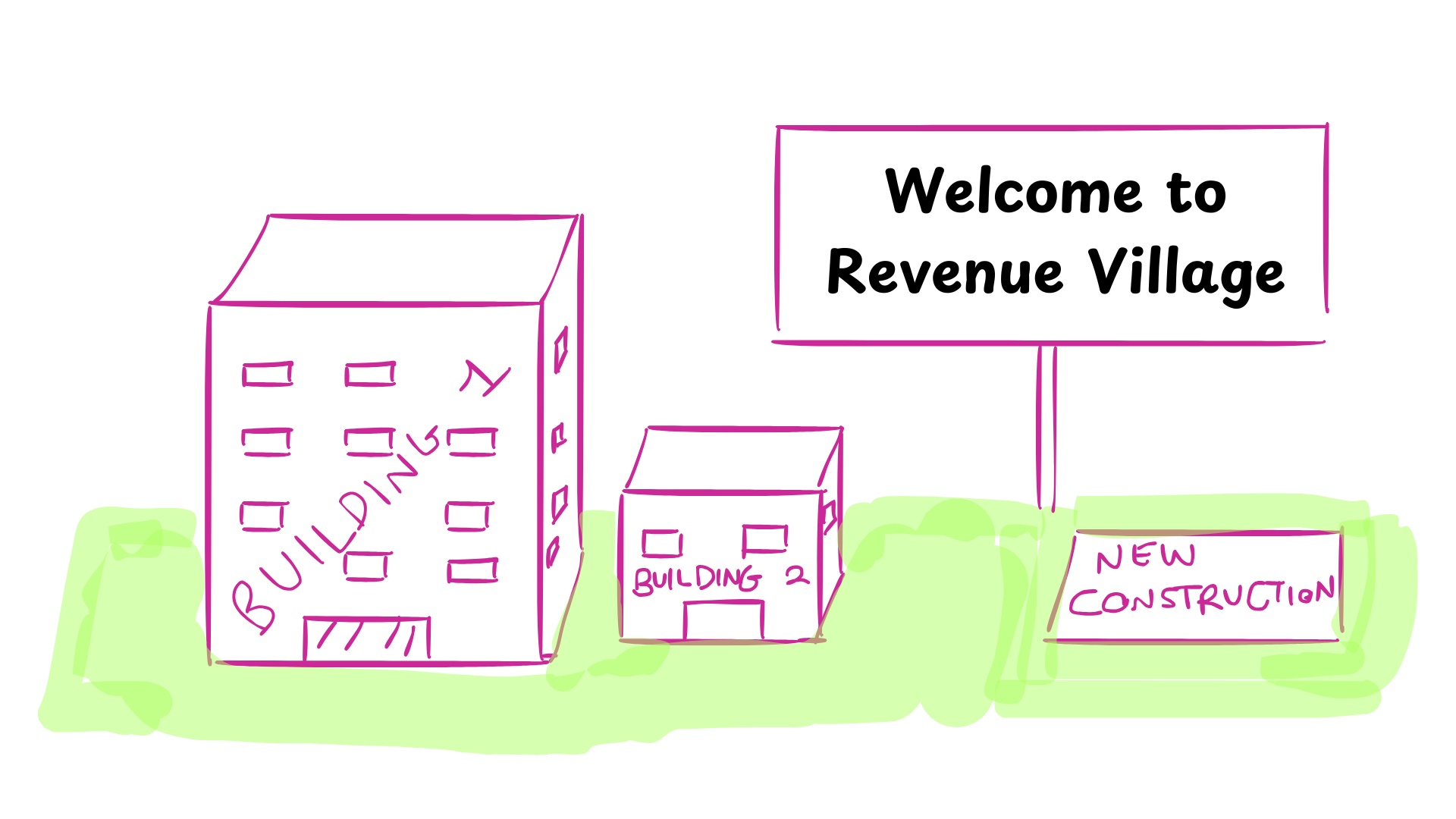
Each “building” in the village generally corresponds to a different revenue stream. For example, if you operate a business that offers personalized consultations and subscription-based courses, then those would be counted as two different buildings—one for the session-based consultations, and one for the subscription-based courses.
However, sometimes, depending on how well you develop and layer your offering and pricing structure, different streams can be combined into one large building.
For most SMEs, though, Revenue Village is usually just one building with multiple stories—each story representing one way that you drive traction to that revenue stream.
We’ll come back to this when we talk about Revenue Village more in depth. For now, simply remember that Revenue Village takes trust, and converts it into money.
Profit Village in a Nutshell
If Revenue Village converts trust into money, Profit Village converts top-line revenue into bottom-line profit.
If you have ever seen a P&L before, then you will know that a lot of items stand between top-line revenue and net income (i.e., bottom-line profit).
These are mostly expenses. Because this is the case, the structure of Profit Village is highly dependent on your operational, cost, and backend structures, and less on your marketing.
However, there is a part of Profit Village that connects with a marketing-related function. This is the section that links with Sector 3 via life-time value (LTV).
Understanding this connection is particularly important for businesses that are stagnating or facing declining ROI on customer acquisition, since LTV maximization is a significant lever of leverage. For this reason, we will cover this topic in a lot of detail across a couple of chapters in this series.
Sector 3—Something Most SMEs Miss
For many small business owners, a sale means the end of the buyer’s journey. But such thinking leaves vast amounts of opportunity untapped and unexplored.
When a stranger becomes a buyer, they don’t just become a “sale” or a “customer.” They achieve client status, which means they move from Sector 1 to an entirely new pool we call Sector 3.
In Sector 3, known as the Loyalty Fields, you can nurture them again and again for future conversions. The best part? You already spent the time, effort, and money to achieve the first conversion. That means that all future conversions come at a much-discounted price.
Nurturing existing clients into repeat clients follows the same process as nurturing strangers into first-time clients. There are A, E, C, and D fields in Sector 3 as well. However, the approach you use cannot and must not be the same, which is why, to make the distinction clear, we’ve labeled these loyalty fields with subscripts of c on them—indicating that they apply to clients, not to strangers.
For businesses focused on reaching the first million, Sector 3 is usually not a place to devote much (or any) thought, except in some rare occasions (e.g., when it’s easier to reach the million by cultivating the loyalty of just a couple of clients instead of acquiring new ones).
However, for all businesses that have reached stability and are seeking to scale, Sector 3 offers the most leverage, because you can get the greatest ROI of any of your marketing efforts.
Why? Because nurturing loyalty increases your client lifetime value (LTV), which feeds directly into Profit Village. Since most of our readers are probably not at this point, we will save the journey into Sector 3 for much later, focusing preferentially on Sectors 1 and 2 first.
However, if you’re nearing the stage where the greatest leverage in your business is activated by Sector 3, rest assured that we will help you unlock your opportunities, too, in this series.
There’s More.
A lot more.
From superfarms to employee digital farms, there can be many spins, variations, extensions, and even modifications to a traditional digital farm.
This is what makes the digital farm so powerful: As a strategic framework, its base model can be adapted and adopted to fit special needs.
So, as we embark on the deep dive journey together, we will explore use cases, case studies, and special examples that are designed to help you visualize, plan, build, and ultimately execute on your own digital farm.
This is not a passive lecture series.
This is your opportunity to rethink your entire digital marketing approach, and is meant to be hands-on. We will ask questions, offer prompts, and help you get well on your way to building your own content-based digital legacy.
Are you ready to get started?
Here’s your first test. How well did you get the key concepts from this chapter? Find out by taking the quick concept check below.
How did you do? Are you ready to move on?
Great.
The journey begins with understanding what we’re cultivating: the trust plant.
Chapter 2: The Trust Plant
A Little Plant that Makes a Massive Difference in Business