
The Digital Farm Series | Chapter 0
The Digital Farm: A New Paradigm for Marketing Your Online Business
By Janette Valoisie | 19 January 2025 | 8 min. read
Imagine you’re standing in the middle of a vast, untapped landscape—land that, with careful planning and consistent effort, could be transformed into a thriving farm.
Now, think of the digital world as that landscape. This is the concept of the “digital farm,” a framework for understanding and approaching marketing in the online age.
While physical farming requires significant investment—expensive land, substantial capital, and years of cultivation—digital farming levels the playing field. Even a bootstrapped startup can begin owning, nurturing, and developing its digital farm with limited resources. All it takes is the right strategy, and the right mindset.
To get the most out of your digital marketing you must learn to think like a farmer.
Let me share a story that illustrates this mindset.
The Farmer’s Mindset: A Lesson in Growth
I have a friend who spent decades as a commercial farmer in Africa.
Week after week, year after year, he supplied fresh produce to various EU countries. His operation was massive, a network of farms producing high-quality harvests on an extraordinary scale.
But what impressed me most about him wasn’t his success or the sheer volume of output he managed. It was the mindset that drove him.
Farmers, true farmers, aren’t in it just for the money.
Yes, profit is essential—but it’s not the ultimate goal.
A real farmer is purpose-driven. They care about cultivating the land, feeding communities, and producing something meaningful. My friend embodied this perfectly.
Beyond his crops, he invested in the people working his fields. He built schools for their children and developed infrastructure for clean water and better living standards. His farms didn’t just grow food; they grew thriving communities.
This mindset earned him respect and influence across Africa, fostering relationships that went far beyond business.
His success wasn’t just a result of his farming; it was a result of his approach to farming.
He understood that long-term growth required intentional care, consistent nurturing, and a vision that extended beyond immediate returns.
The Digital Farm: Applying the Farmer’s Mindset to Marketing
In the same way, your approach to digital marketing should reflect the farmer’s mindset.
When you view marketing as a series of disjointed, short-term actions—an ad here, a post there—you’re scattering seeds haphazardly, hoping something will grow. This sporadic effort rarely yields meaningful results, leaving many to conclude that digital marketing is ineffective.
But the problem isn’t the digital landscape; it’s the approach.
A farmer’s mindset shifts the focus from short-term tactics to long-term cultivation.
Here’s how:
- Care About What You’re Growing: Every piece of content, campaign, and interaction should be intentional and aligned with your audience’s needs and your business goals.
- Nurture Consistently: Growth doesn’t happen overnight, just like crops don’t instantly sprout from seeds sowed in the ground. You need to employ regular effort to build trust and momentum.
- Think Long-Term: Like the best farmers, plan for the future. Build a foundation that will sustain your business for years to come.
Leasing and Owning: Navigating Digital Real Estate
In the physical world, not everyone owns land. Some lease or rent—and the same is true in the digital realm.
Platforms like social media represent rented space. You can grow on these platforms, but they aren’t fully yours. Algorithms shift, policies change, and control remains in someone else’s hands.
Owning your digital farm means investing in platforms you control—like your website, email lists, and original content. While rented land can be a valuable supplement, true sustainability comes from cultivating what you own.
How Does a Digital Farm Work?
Similar to a traditional farm, a digital farm is made of different activities, processes, and assets that all work together toward a shared goal.
Your digital farm, regardless of size, should aim to move a total stranger from the unaware phase of their buying journey into a happy, thriving, and satisfied client. That means, in its entirety, the digital farm will attract, engage, educate, inspire, and build rapport and trust with your ideal prospects, ultimately converting them into clients. And even beyond that, it will continue to delight and nurture that relationship long after they’ve made that initial purchase so they can turn into repeat clients.
Is This Practical, Though?
The challenge of taking on such a huge and long view for a startup is that you just don’t have the resources to undertake such a project. Cash flow does not permit those without VC funding to take their time building out such ecosystems.
So what does that mean? Are bootstrapped startups excluded from this opportunity?
Not at all.
We developed this digital farm concept because, after spending years in the marketing space helping various solopreneurs, startups, and small-to-medium-sized businesses, we’ve recognized the need for a formula that empowers businesses of all sizes to create leverage. And, in that light, we’ve developed various add-ons and modifications to suit your business, whatever size it is.
Jay Abraham (our master marketing shīfù) often talks about learning to gain leverage in business. But usually it’s tough for an underdog to gain leverage when you’re just trying to stay afloat and pay salaries.
Farms are not inherently built for quick results. But after much trial and error, we’ve figured out a model that enables any startup to invest in marketing through the lens of a digital farm, with an added layer that builds leverage on a shorter timescale.
We call this the D-Model (you may have heard of it :D).
Following this model—now in the context of a digital farm—you can focus on the aspects of your farm that are mathematically calculated to bring you the highest ROI in the shortest timeframe possible.
That way, you are building your digital farm, cultivating a sustainable long-term profit-building machine, and at the same time keeping the business afloat with cash flow-producing activities.
Now, isn’t that great leverage for a bootstrapped startup?
What Are the Components?
The size of your digital farm can be as small as a backyard garden or as large as a 10-acre farm. It really doesn’t matter. What matters is that you have all the key elements in place to make it a self-sustaining cash-producing mechanism.
These elements are:
- the “fields,” where you cultivate and nurture client trust—these directly follow the D-Model
- the “villages,” where you convert trust into money for your business and optimize the money you receive
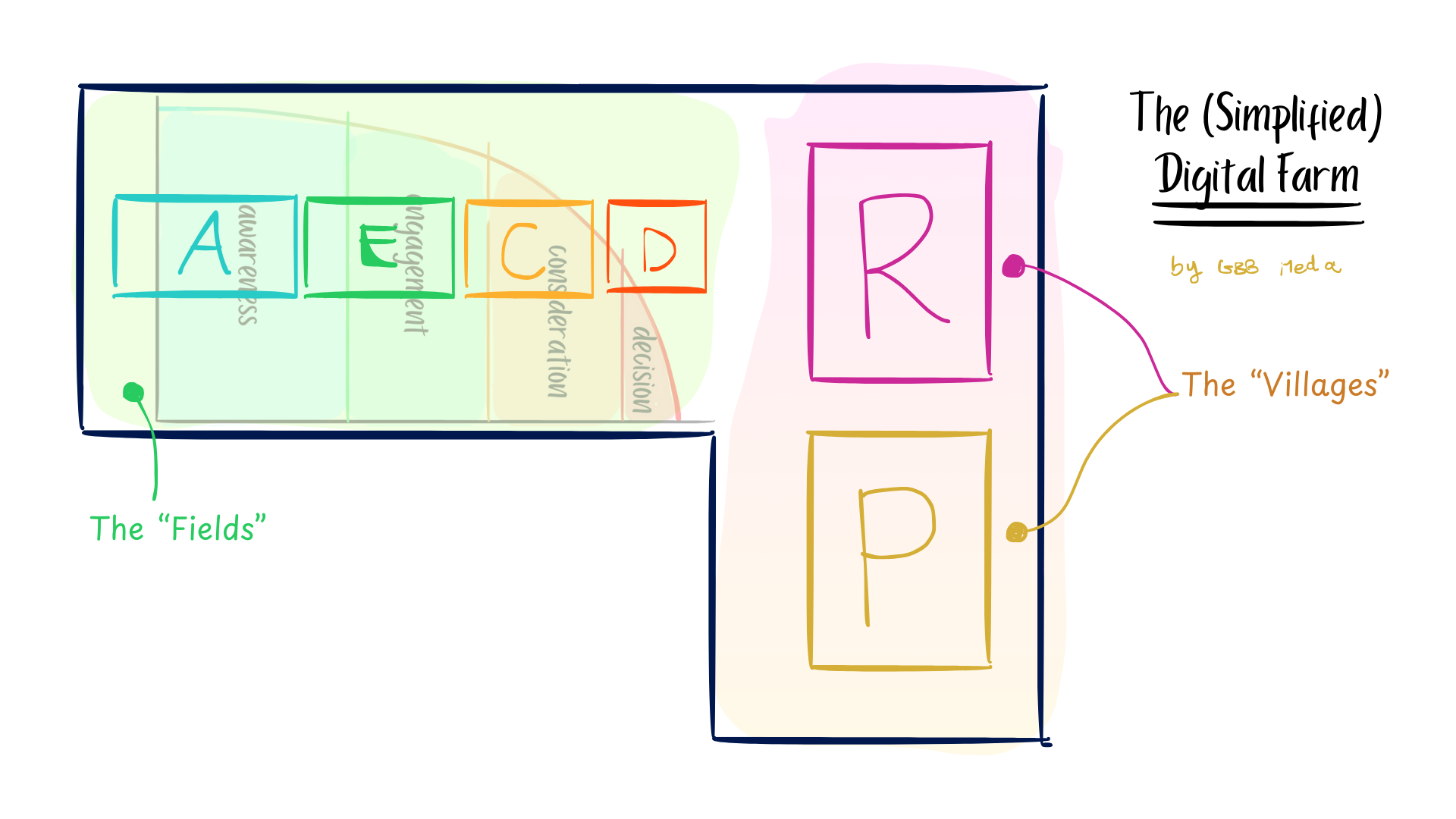
I’ll leave it to our technical writer at GBB to do a deep dive on these components, how they work together, and how to cultivate and optimize them.
But for now, here’s what you need to know: Client trust is what you must cultivate through your campaigns, assets, and other efforts. And if you invest in cultivating the trust of prospects who are in high need for your product or service, then you’ll be able to maximize your ROI on the shortest timescale (this is where the D-Model comes in very handy).
Cultivate with Intention
The key thing to remember is that if you want to build scalable and sustainable results, you can’t let yourself indulge in ad-hoc, random, or short-term marketing efforts.
Reflect on the story of my friend, the farmer. Are you planting with care and intention, or are you scattering seeds and hoping for the best? Are you building something sustainable, or are you chasing short-term wins that leave your soil barren?
The digital world is fertile ground for growth. Whether you’re a startup with limited resources or an established business with capital to invest, the principles of farming—patience, consistency, and purpose—can guide your marketing efforts to extraordinary results.
So, ask yourself: What kind of cultivator will you be?